You can access the PDF document by clicking this link.
|
The Vale’s conservation area appraisal of Great Coxwell is now published on the District Council’s website https://www.whitehorsedc.gov.uk/conservationareadocuments
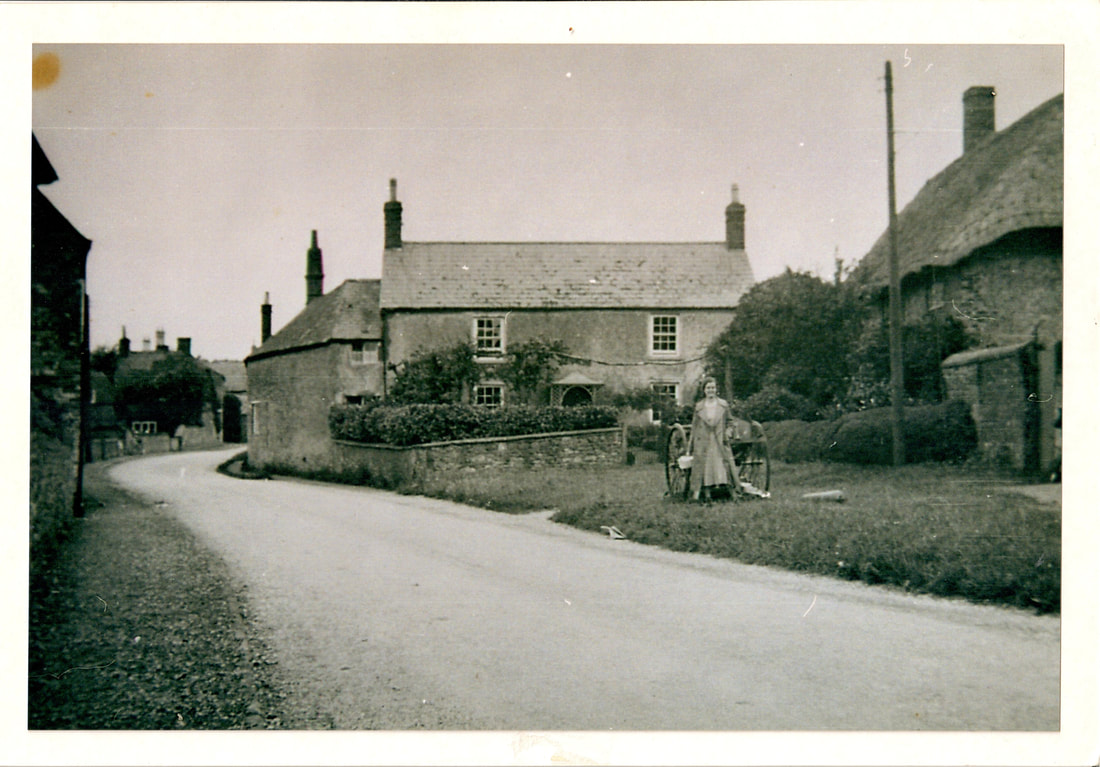
You can access the PDF document by clicking this link. Great excitement today as I found and read a copy of the neighbourhood plan for above. I recently visited Great coxwell with my son and grandson when we dropped said grandson in Oxford to study and couldn’t resist bringing them to see where I lived for a few years and attended the village school during the 2nd world war. Myself and my brother and sister went to live with my aunt and uncle who lived in the house (I believe now divided into 3) i.e. I believe from the map Jenners and Pear Tree Farm and I believe properties on either side are listed, attached to what was then the public house called “The Royal Oak“. My mother had died (we lived in Cheshire I believe,) at the age of 32, and I was aged 4 and young as I was I have many memories of my time there I think that the pub was open only occasionally and I think my uncle ran it when open as he also work at Watchfield (I think an army base) as well. My uncle and aunt were named Harold and Doris Hunter. I remember the school and how we wrote on slates and sand trays also there was only one teacher for the whole school. Our milk was delivered in churns in a pony and cart that we labelled Cox's cavalry as it was Mr Cox who drove it he lived in the village and I believe sold black market cigarettes from his back door. I well remember the church and actually my grandfather Captain Clark who fought in the Boer War, also was in India where his daughter was born i.e. Doris Hunter, is buried in the village churchyard I also remember the Americans who sometimes came to the pub bringing chocolate and gum and silk stockings to us!! We had the VE party on our lawn and the whole of the occupants of Great Coxwell came to tea and I still have the China that was used. Post office was run by a Mrs Swindles who had a daughter called Phyllis, and coincidentally I saw in the neighbourhood plan a desire for a village shop. Well in my day there was one, and the elderly lady who ran it dressed in a long dress and bonnet, there was very little stock in the shop and she kept the money in an OXO tin. We also had a boy billeted with us from the east end of London called Alfie who much to my aunt's delight became as a son to her. We also had a prisoner of war came every day to help in the garden, a very large garden complete with a stream. Pigs and goats as there were no other houses behind ours and as you can imagine it was a large garden. He too became as one of the family and painted many lovely oil paintings in our stables and back at his presumably close by POW camp. I have many more memories, in fact more than I have of my recent past also a few photos if you are interested. My name is Mrs Kay Creed nee Clark (address withheld - Editor). I am in my 80s but think my memory is not too bad. I also remember the pump! Since writing this I have amazed myself as to how much more as a small child I can remember I must say having seen your wonderful Reading Room teas I am tempted to "come to tea" one day. I will continue to try and remember more of Great Coxwell in the war and perhaps write my musings down. It is obviously a much larger place now than it was at the beginning of the war but I do remember it being a very friendly caring village with many celebrations, parties and fancy dress events. Of course nearly all knew what the others did!
Kindest regards to Great Coxwell and all its inhabitants you live in a very beautiful village. Kay Creed I was passed some old village photos recently which I thought might be of interest. Click on the image for the original. If anyone has anything to add or further information please email [email protected] I have been unable to find the copyright owners for these, if you are the owner or need a photo removed please email [email protected]
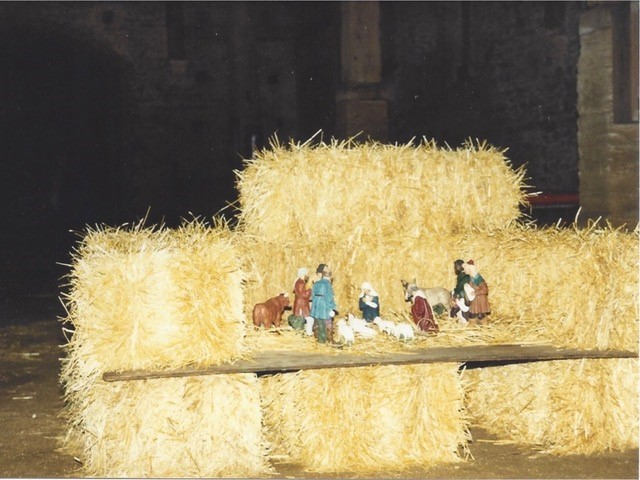
This village tradition has continued since the turn of the millennium, with a hiatus of only one year (2020) due to the coronavirus pandemic. Below you can read several people's memories of the early years. This year saw 134 people join in the carol service at the Great Barn. The brand new 'Inn at Danes' provided some festive cheer and raised £200 for village funds. Thanks to everyone who helped with dressing the figures, assembling the crib scene, ensuring the safety of the event, and putting the service together. Christmas Eve Service in the Great Barn It was so good to be able to hold the annual Christmas Eve service in the Great Barn again! Thanks to everyone who took part, especially the Armstrong family who provided not only Mary and Joseph but also one of our readers. Thanks to the generosity of everyone who donated, the collection amounted to just over £200, half of which is in the process of being sent to help children in Chennai, in India, via the Batemans Trust. If you wish, you can find more about the excellent work they do on their website or see their annual newsletter in the Church. The other half will be a welcome addition to the Church funds, especially if these high winds result in more tiles coming off the roof this winter and spring. From Joy Lee Dear village, I am more than delighted that the event in the Great Barn is to go ahead. It was originated because I saw, through a crack in a barn door, in Prague, the forms of life-size sized figures of the Nativity. It was in communist times and, of course, there was no religion. I haunted the building until I found a crack in the door and, behold, the figures! From Jennifer Norman A bit about the Nativity in the Barn, it was the inspiration of Geoff Lee and made by people in the village with the Carols etc for the children in 1999. John Rounce, Richard May and l met during the year planning and who else could help, Peter Turner constructed the stable, someone else the electrics, John Rounce made the Angel which ‘flew’ up to the barn on the top of his car, how tall to make the figures etc. I was asked to make the costumes and robe the figures. Thoughts on the materials which could withstand the cold, wind and rain. Mary - A white shift which was given. A piece of velvet l had , quite old Joseph - A dental gown, given by dentist living in the village. Made stripey overcoat, head scarf and Turks head band. Baby Jesus - Swaddling clothes. Shepherds - Gaberdine material given. Ponchos hessian given. Headscarves and torques, made Kings - Gold - Shift from old sheet, tabard from my gold velvet curtains. Red scarf given to me, Christmas cracker brooch. Headdress, someone else made the crowns which were later replaced when we once had some vandalism. King - Green - Shift. Green curtain. Gold headdress King - Purple - Tabard, material given. Gold neckcloth and purple headscarf. It was fun to do, but handed over when Rex was ill in 2009 and of course realise that it is right as younger people take over and may change. It has certainly has many visitors each year. From Ian Beckwith THE PREQUEL TO THE NATIVITY SCENE IN THE GREAT BARN Before the present Nativity Scene was designed and installed, there was another version.
In 1997, in my first year as priest-in-charge, like the proverbial new broom, I was fossicking about in the vestry of St Giles and came across a complete set of ceramic Nativity figures, possibly German in origin, each standing about nine or ten inches tall. They been wrapped in newspaper, put in a box and shoved away in the back of a cupboard, there it seemed to lie forgotten until I accidentally found them (there was also a second, rather smaller, set). They were too nice to be left in the dark. Yet to people a Nativity Scene with them would require a bigger setting than St Giles has room for, or so it seemed to me. So the plan to set them up in the Great Barn came about and with it the idea of starting the Midnight Mass of Christmas with a short candlelit service of Blessing the Crib in the Barn, followed by a procession through the village to the church, singing the Christmas introit hymn, O Come All Ye Faithful. Adam Twine, then at Colleymore Farm, Coleshill, who had the use of the Barn, gave his permission and lent me some pallets and Ann-Marie and I set up the figures I had found. I suspect that it was their first appearance on stage for many years. If, in St Giles, they might have been overwhelming, in the Great Barn they appeared tiny, even insignificant – but then so were Mary and Joseph before the might of the Roman Empire. Christmas Eve came, a small gathering met round the Crib in the Great Barn, I read a Bidding Prayer used by the Iona Community, blessed the Crib and then we formed up in twos and processed through the village singing, led by the cross and our organist, Iain Wright, accompanying O Come … on his accordion while walking backwards along the street in the dark (Gt Coxwell has always had talent!). Even though it was nearly midnight, people stood on their doorsteps to watch us pass. Meanwhile the church was deliberately left in darkness, where Iain’s father, dear Grahame Wright (village historian extraordinaire) sat alone, waiting quietly for us. Ann-Marie had set out candles in jars to light our path to the church. As the head of the procession entered the church porch, the lights went on, the altar candles were lit and Midnight Mass began. It was, by the way, normal for the congregation on this occasion to include two very well-behaved dogs. It was also one of the two occasions in the year when incense was used, but the dogs didn’t seem to mind. On Christmas morning I had services to take at Coleshill, Buscot and Eaton Hastings, involving some speedy entrances and exits, not to mention the consumption of enough communion wine to take me over the limit (our wonderful community police officer said that he wouldn’t pull me over on Sundays or High Days and Holy Days). When eventually I got back to the vicarage, Ann-Marie had packed a small picnic for us to take up onto White Horse Hill, where we sat in the car, counting the coloured counties and unwinding. On that first Christmas Night (1997) a wind got up and by bedtime had turned into a gale. We decided to check that the Nativity Scene was safe. Wrapped up in more clothing than we could move in, we battled our way against the wind to the Barn. It was just as well that we did so, because the double doors of one of the transepts had blown open, and the wind was whistling through the Barn, threatening to upset the fragile figures, rocking on their pallets. Ann-Marie is 4ft 10ins high and slight with it, but somehow we managed to pull the doors together and get the bar into the slot that holds them. Twenty-four hours earlier we had been standing in the Barn in the peace and quiet of the Blessing of the Crib. Now, with the great doors secured, the interior of the Barn fell silent again, the only disturbance being the gale roaring round outside. Mary, Joseph and the child were safe for the time being. Old Herod in the form of the gale hadn’t got them yet. It was hard not to feel satisfied with ourselves as we were blown back along the street, to the vicarage and bed in the early hours of Boxing Day morning. Was Boxing Day that year a Sunday? – if so, there were more services and I had to be up betimes. The following year (1998), the pallets were replaced by straw bales. The dogs were in their accustomed pews (they probably only came for the incense). All services over, we took our Christmas Morning picnic up to White Horse Hill. There were no more gales. Incidentally, in those three Christmases, 1997, ’98 and ’99, before the old Crib figures were replaced by the new, we kept the tradition of not adding the Three Wise Men before their appointed time, the Feast of the Epiphany on 6th January. They did not arrive at the same time as the Shepherds and nor did the Shepherds and their flocks hang about, waiting for the Three Wise Men to get there from Persian lands afar, by which time, in any case, the Holy Family had probably left the cave-stable in Bethlehem and returned to Nazareth. And finally, no account of the origins of the current Nativity figures should overlook the essential part played by Helen Anderson’s artistic oversight. I came across this and thought others might find it of interest, some of the facts seem a little out but may be the result of keying in the data - for example:
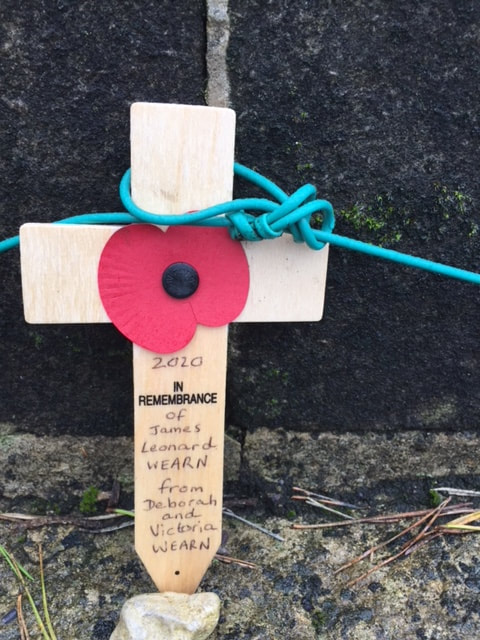
"The village, which contains few houses of interest, straggles down half a mile of a lane running south from the Highworth road. The church of St. Giles lies back from the road near the southern extremity, the school being further north. A little beyond is the Independent chapel, built in 1875. The reading room was opened in 1801, the site having been given by the late the Hon. Duncombe Pleydell-Bouverie." For 1801 we can read 1901, the description otherwise seems a little harsh. There is a long description of the Church and the local name Webb crops up a couple of time. If you have anything to add, let me know at [email protected]. Citation: 'Parishes: Great Coxwell', in A History of the County of Berkshire: Volume 4, ed. William Page and P H Ditchfield (London, 1924), pp. 487-489. British History Online http://www.british-history.ac.uk/vch/berks/vol4/pp487-489. Whilst walking through the village with grandchildren 2 weeks ago, I stopped at the War Memorial to show my granddaughter the name of my Uncle, her great great Uncle, James Leonard Wearn who was killed in the Second World War. To my amazement placed beneath his name was a small wooden remembrance cross which had been written on with
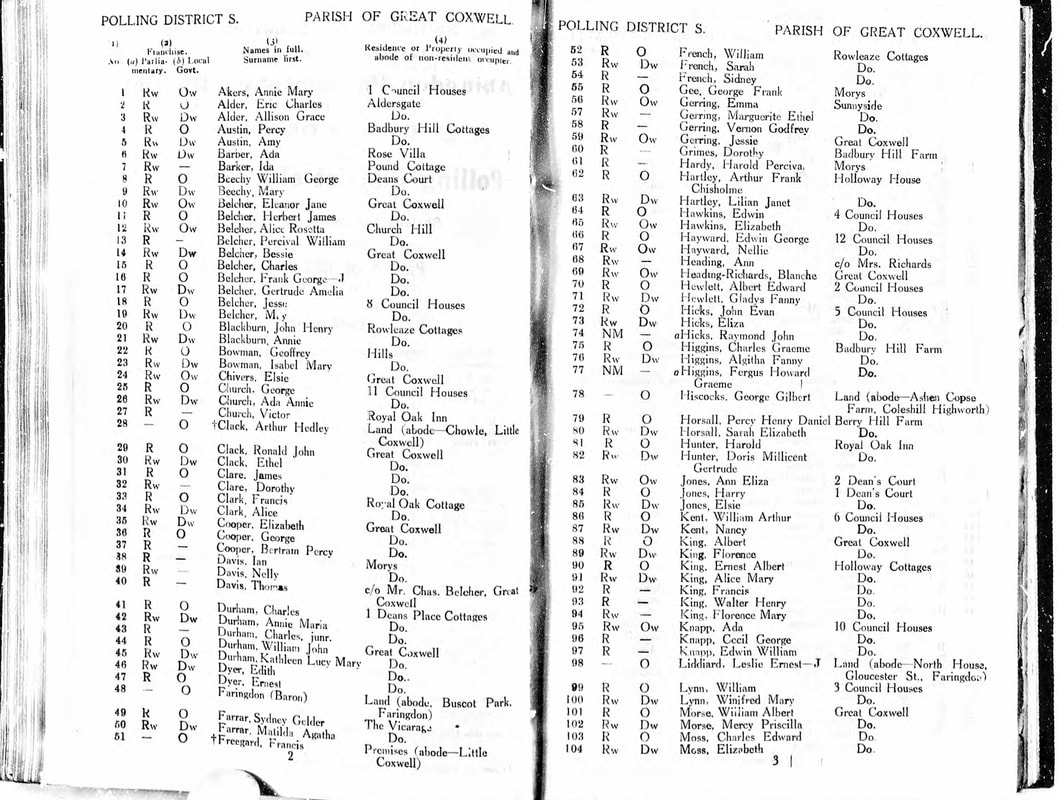
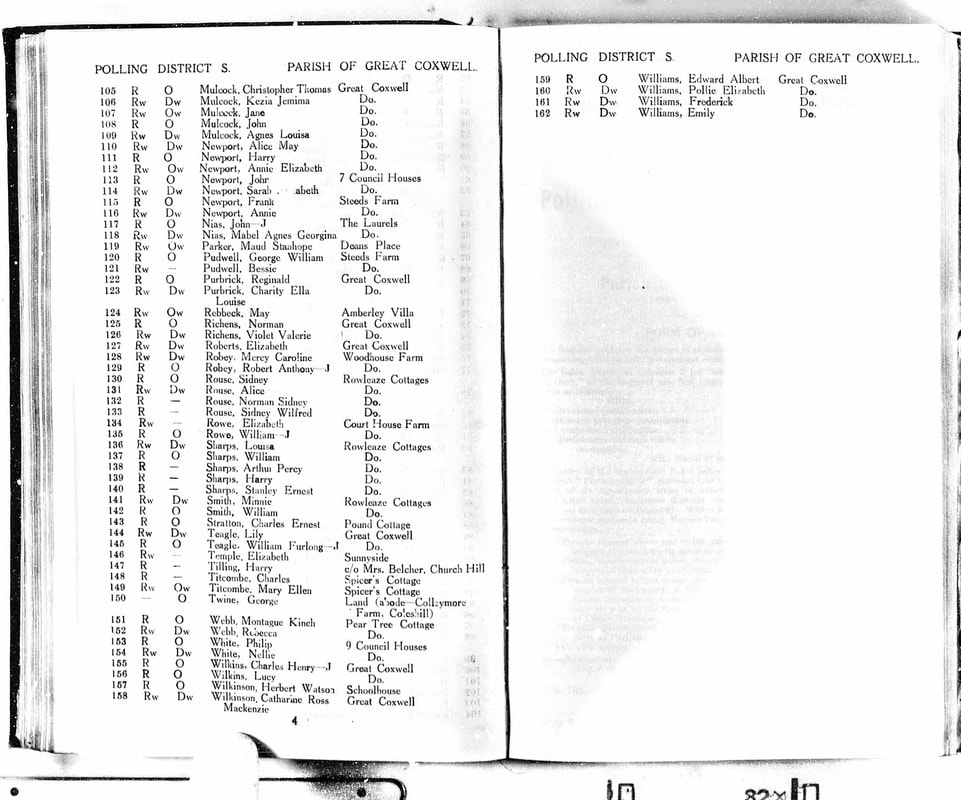
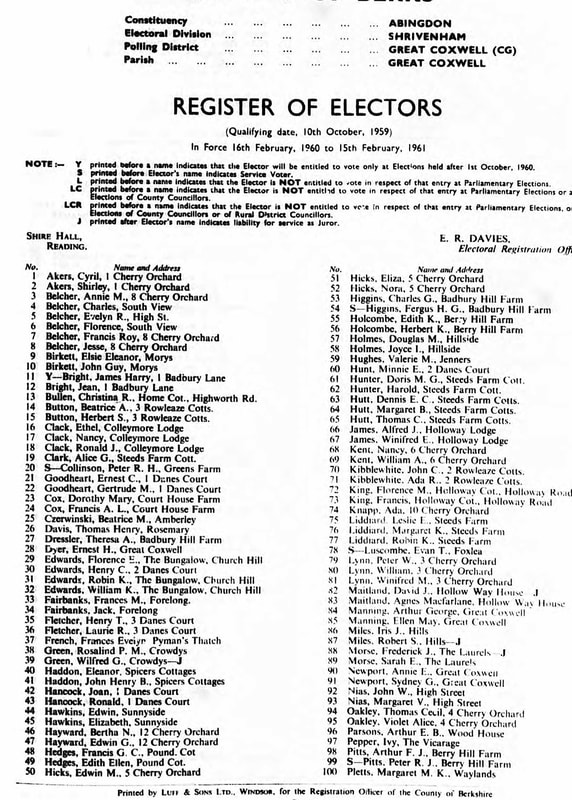
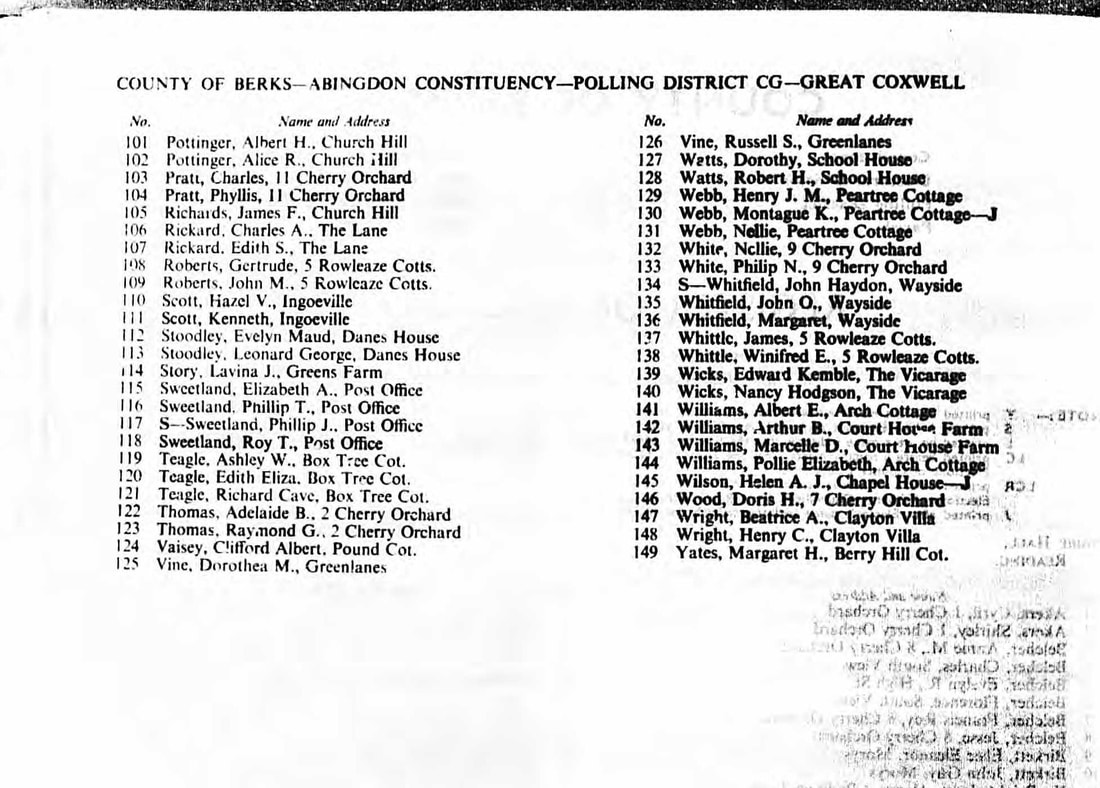
“2020 In remembrance of James Leonard Wearn from Deborah and Victoria Wearn” I immediately phoned my sisters and brother who were completely unaware of the existence of the 2 ladies who are apparently related to us. Mike While doing some research on Ancestry I came upon the Electoral Register for Great Coxwell for 1959. By digging further I reached the 1935 Electoral Register. I have found them very interesting and a number of people in the village have expressed interest (or already had copies from me), so I thought I would make them available to you all. There are a number of names that will be very familiar. I also have a register from 1939 which is more like the usual census, giving all people in a household, their dates of birth and their occupations. However, the images are very dark so I will have to clean them up as much as possible to make them more legible. If I succeed I will put them on here shortly. I shall also see what others are available.
Dear Editor of the Coxwell Newsletter.
Thank you for publishing the story of Marian Czerwinski. It is important to have it recorded. I wonder whether the Oxford Polish Association would like a copy (I have sent a copy - Ed). I well remember Marian’s smoke-emitting Robin Reliant. One of its incarnations burst into flames on the corner of Puddleduck Lane, leaving black scorch marks on the wall of what was then Helen Anderson’s house. Ann-Marie and I look forward to receiving our copy of the Newsletter and enjoy reading about life in Gt Coxwell, where we had five very happy years. Best wishes Ian Beckwith (Vicar of Gt Coxwell 1997-2002). We've had this link on the home page for a while, but here it is again if you have never seen it, from the BFI web site
"This travelogue of the countryside around Great Coxwell and Faringdon was sponsored by Shell-Mex, and written and narrated by poet John Betjeman. Great Coxwell was in Berkshire until 1974, when it became part of Oxfordshire after boundary changes." Watch the 3 minute black and white film from 1955 here. This second film from 1952 is 5 minutes long and without dialogue, but in colour, to quote the BFI"In the market town of Faringdon in Berkshire (it transferred to Oxfordshire in the 1974 council re-organisation) a carnival is underway to raise funds for All Saints' Church. The unusually squat tower of the church is a legacy of a Civil War cannon ball that drastically reduced its height in 1645. This historical oddity is commemorated on one of the floats in the brightly decorated parade captured in vivid Kodachrome by Joyce Skinner. Look out too for an appearance by an American military band that is visiting from Fairford in Gloucestershire. The United States Air Force were running the base at the time as the Cold War escalated. The filmmaker, Joyce Skinner, was later a member of the South Birmingham Cine Society and went on to make several sponsored industrial films and prize winning amateur productions." Watch it here Enjoy! |
Categories
All
Archives
May 2026
AuthorThis site is run by the parishioners of Great Coxwell for the benefit of everyone. Please submit information, ideas and comments so that the site can be developed to best effect. |


RSS Feed